Channel operations for faceless YouTube
Run several faceless channels without losing track of quality or the rules.
Moorfold finds what viewers really watch, plans and produces the video, checks it before upload and prepares it for publishing.
For solo creators and small studios running three or more faceless channels. You make the few decisions only you can make; every statement here links to the test behind it.
Where we are. The line is proven on test episodes with stand-in services. Live publishing to YouTube is in development: the upload path is tested against a stand-in YouTube, and no film has been published yet. In development Access is by request while we run the first channels. What happens when you write

Statements on this site, by state · how we count
- Passing their tests
- 72
- In development
- 28
- Planned
- 2
- Test files
- 66
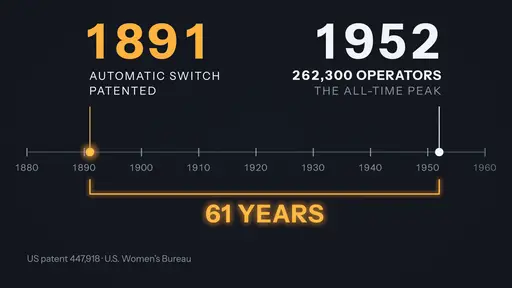
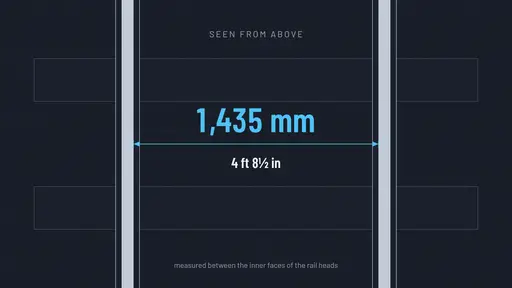
Frames from Episode 001, our test film, rendered by our own motion-graphics engine (example data).
The line
Frames on a belt, through seven stations.
One production line runs every channel. The fourth station is the check: it can stop a film before it reaches upload.

- 01Find
- 02Format
- 03Make
- 04Check
- 05Dub
- 06Publish
- 07Protect
Frames: renders of Episode 001's motion graphics (our test film, example data). The moving view needs WebGL and stays still if you prefer reduced motion.
One channel is a craft. A dozen is an operations problem.
The hard part is not any single step. It is keeping every step honest when you run many channels at once: choosing topics people actually watch, shipping on schedule without quality slips, and staying inside YouTube's rules while you do it.
What Moorfold is.
A control room for that line. The rest of this page shows what each part does, with its evidence beside it.
What it is not
Not a button that makes viral videos.
We do not promise views, monetization or growth.
Not a way around the rules.
YouTube is written to only through the official API adapters, and nothing in the system automates clicks in YouTube Studio.
Quota is never multiplied by splitting channels across several Cloud projects.
Not a vault for your logins.
The system never sees, stores or types a password: you log in on the provider's own page, and it only points each tool at its own login folder.
Evidence 4 test files, listed on the status page
How it works
Seven steps from a topic idea to a protected, dubbed channel.
Each step names what the system does. Where a person decides, it says so.
Find.
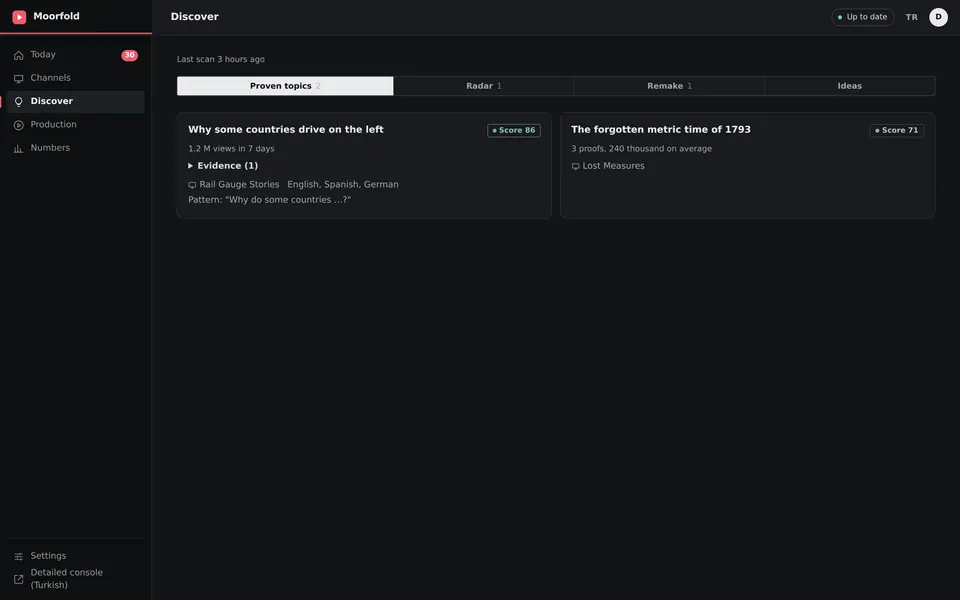
Demand is measured in absolute terms, not only against a channel's own average, so a topic counts as proven only when videos on it are really being watched.
Choose the format.
From discovery evidence the studio recommends which format a channel should run and gives the per-episode plan that format implies. In development
Make.
A separate renderer builds long videos and vertical Shorts from a format plan, beside the original documentary engine. In development
Check.
An automated reviewer checks every long film and every Short before it may be published, and returns green, yellow or red.
Your partYou do not watch every video: the reviewer lists the suspicious moments with time stamps and frames, and picks a random two-minute window for you to watch.
Dub the winners.
Our own dub tracks are made only for winners: videos that pass a seven-day performance threshold, in the three to five most valuable languages for each video's audience.
Your partYouTube has no audio-track upload endpoint, so the last step is a guided Studio task: files in priority order, every value copyable, about two minutes per language.
Publish and grow the line.
A video is uploaded as private first and released only after an approval that is bound to the exact version shown, and the system never deletes a video or makes a public video private.
Protect and learn.
When views rise or fall, a report explains why and from where: traffic sources, search terms, suggesting videos, geography, devices, subscribers against others, Shorts against long videos, and your own title and thumbnail changes.
Steps four and six are where you decide.
Evidence 11 test files, listed on the status page
Features
Seven parts of one line, each with its evidence.
Discovery
Find topics by demand, not by hunch.
A topic idea is a guess until videos on it are being watched. Here is what we measure before a niche qualifies.
- Demand is measured in absolute terms, not only against a channel's own average, so a topic counts as proven only when videos on it are really being watched.
- Estimated or incomplete numbers never reach a qualification gate, and a question the evidence cannot answer stays open instead of passing.
- We try sixteen ways to disprove every candidate niche before accepting it, and the evidence against it is kept next to the evidence for it.
Evidence 5 test files, listed on the status page
Format and character studio
Give each channel a format and a face that stay the same.
A channel is recognisable because its structure, pacing and character repeat. Here is how those choices are kept.
- The format catalog defines twelve production formats, each with its structure, pacing, visual mix, voice, captions, thumbnail style and Shorts rules.
- Eleven of the twelve formats are in development; only the archive documentary is marked as running today. In development
- A character bible fixes a recurring character's role, speech rules, look and palette, and every later scene prompt is checked against its must and never lists. In development
Evidence 3 test files, listed on the status page
Production line
Nothing reaches upload without passing its checks.
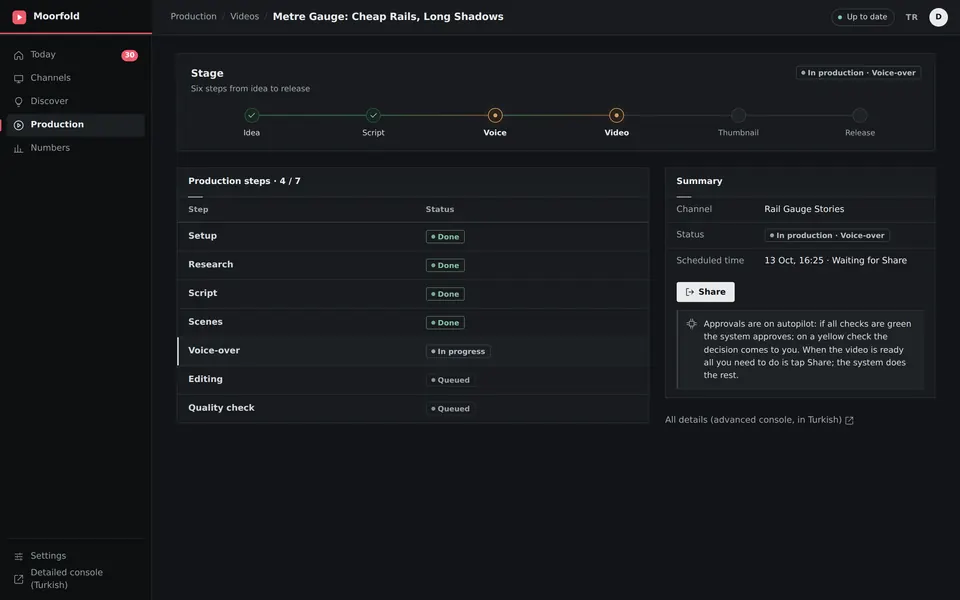
Quality is cheaper to fix before upload than after. These are the checks every video passes.
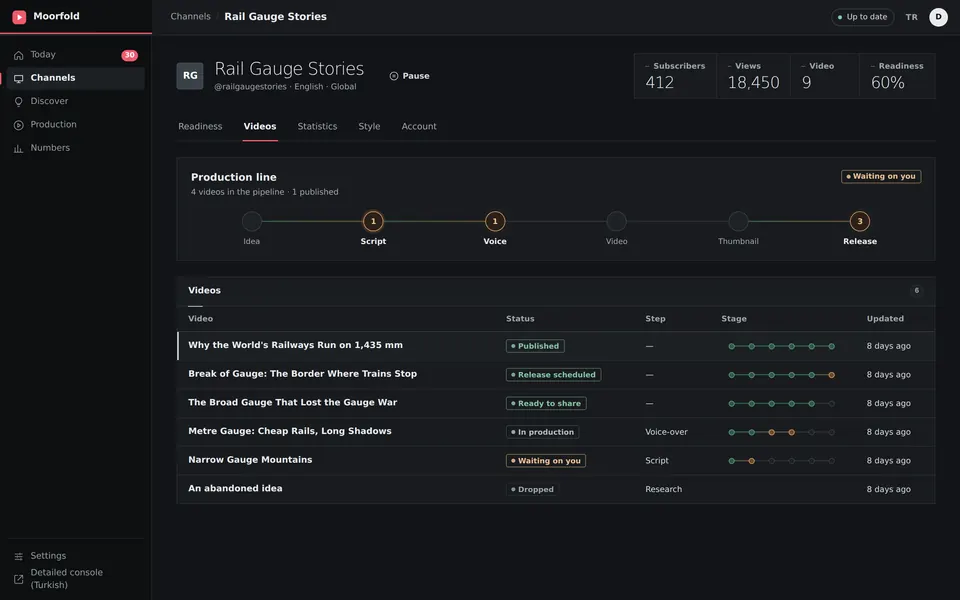
- The final render stays blocked until the script, the pictures, the rights and the voice are each decided.
- The review covers technical quality, captions, voice, picture and content, and a red verdict blocks publishing and plans an automatic retry. In development
- You do not watch every video: the reviewer lists the suspicious moments with time stamps and frames, and picks a random two-minute window for you to watch.
Evidence 1 test file, listed on the status page
Dubbing
Spend dubbing effort where a video has proved itself.
Dubbing costs effort for every language you add. Here is how we decide where it is worth it.
- Our own dub tracks are made only for winners: videos that pass a seven-day performance threshold, in the three to five most valuable languages for each video's audience.
- Each dub is placed scene by scene against the English master's timing; a take that runs long is re-spoken faster, rewritten shorter, or sped up by at most ten percent.
- A scene that would have to be cut fails the track's check, and a failed track is never offered for upload.
Evidence 2 test files, listed on the status page
13 languages: English plus twelve dubs
- English (master)
- Spanish
- Portuguese
- German
- French
- Japanese
- Korean
- Chinese
- Italian
- Dutch
- Russian
- Indonesian
- Hindi
Listed from lib/i18n/languages.js when this page was built.
Channel ramp and publishing
Open channels as fast as the earlier ones earn it.
More channels only help if the first ones are healthy. Here is how the line grows, and what limits it.
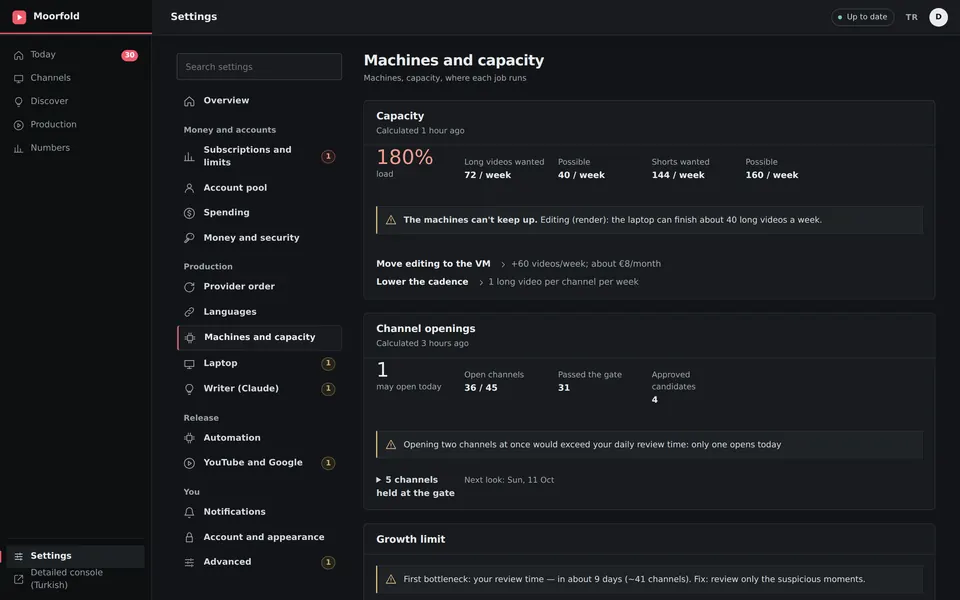
- New channels open through a quality gate: earlier channels need at least four published videos, a review pass rate of at least eighty percent, no strikes and no open claims. In development
- The ramp does not stop at a fixed number of channels; a forecast names the limit that will bind first, when, and the concrete fix. In development
- Live publishing to YouTube is in development: the upload path is tested against a stand-in YouTube, and no film has been published yet. In development
Evidence 4 test files, listed on the status page
Policy and growth
Know YouTube's rules before they cost you a channel.
If you do not know YouTube's procedures for claims, strikes and policy changes, you are not alone. Here is what the system does about it.
- YouTube and AdSense notices are read from your Gmail with a read-only permission, sorted by kind and severity, and a sender that is not official is marked suspicious and never acted on. In development
- When a strike or claim arrives it takes only safe, reversible actions itself: it holds the channel's scheduled uploads, holds similar queued content and prepares the dispute package; it never takes an irreversible step without you. In development
- The control panel works in English and in Turkish: every screen takes its words from one dictionary per language, and you switch the language in the panel.
Evidence 3 test files, listed on the status page
Accounts and cost
Use what you already pay for, and see what is left.
The cost of running many channels is mostly subscriptions and compute. Here is how the system keeps both visible.
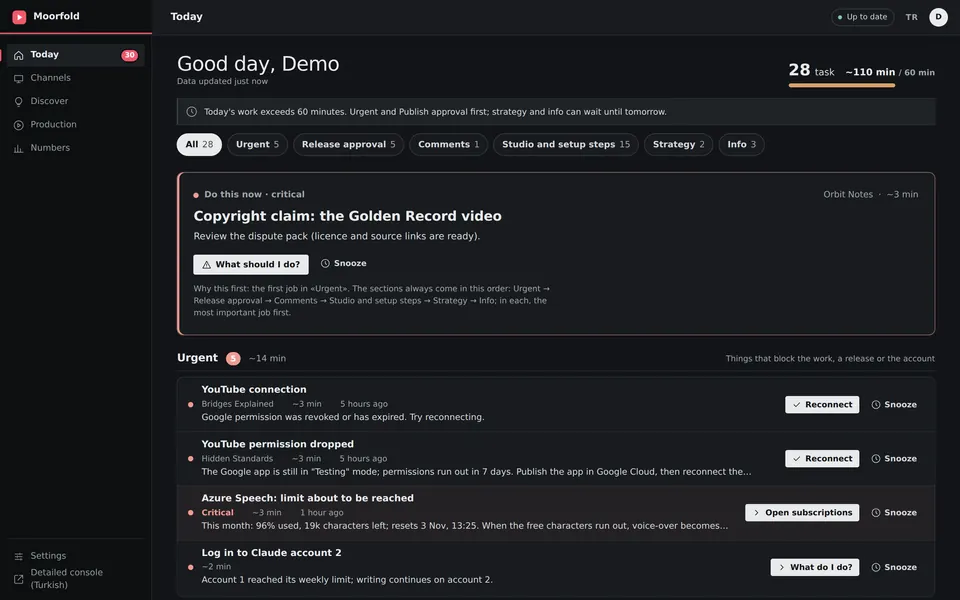
- Each subscription can hold several logged-in accounts; when one reaches its limit the next one answers, and when none is left the panel asks you to log in to another.
- What is left of every subscription and limit is shown with a warning at a critical level, and spending is tracked by month and by channel.
- A capacity plan says how many long videos and Shorts a machine can finish each week, and when demand exceeds it, it warns you with concrete options.
Evidence 5 test files, listed on the status page
Proof
Proof, not logos.
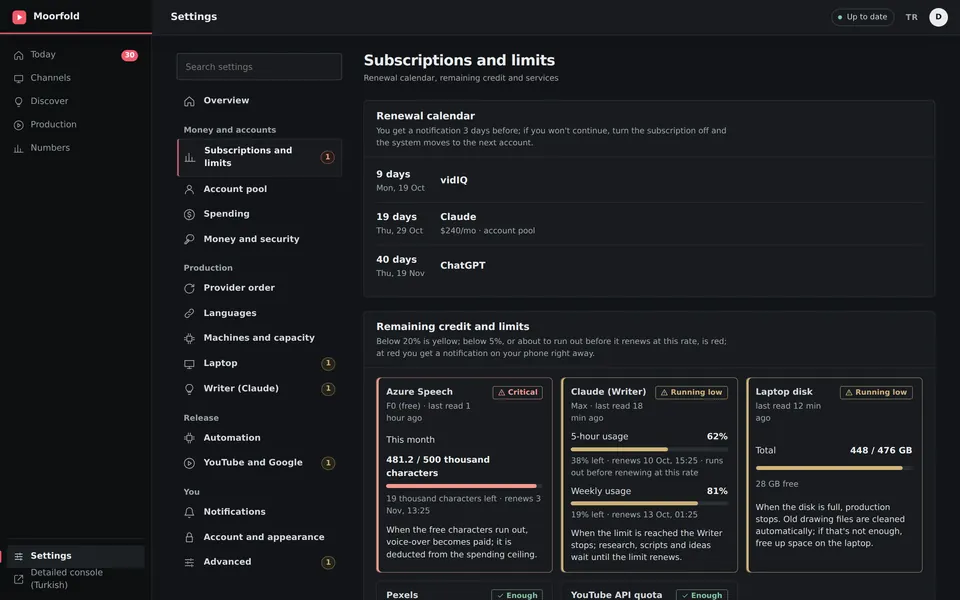
72 statements on this site pass their tests or rest on shipped files. 28 are labelled in development and 2 as planned. 66 test files stand behind them, and 33 status-map tests ran and passed when this page was built on 10 Oct 2026 (commit 3381938).
Every feature statement on this site is mapped to automated tests or to a shipped file, and a statement without evidence fails our test suite. 2 tests
- Working statements
- 72
- In development
- 28
- Planned
- 2
- Test files behind them
- 66
Packages
Start on your computer. Move the heavy work to a server when you need to.
Your computer
Local
Local runs every step on your own computer: discovery, writing, rendering, voice, upload and analytics, with no server and no extra monthly server cost.
Ask about LocalOne server
VDS Standard
VDS Standard moves the heavy steps to one server: rendering, voice, dubbing, upload and discovery. Work already handed to the server finishes while your computer is off; new work starts when your computer is back on.
Ask about VDS StandardUp to two servers
VDS Pro
VDS Pro adds a larger server, parallel rendering on up to two servers, and an object store for render transfer and backups.
Ask about VDS Pro
VDS means a rented virtual server; you pay the hosting provider for it directly. Packages are not on sale yet; prices will be published on the packages page before anything is sold. Planned Compare the packages
Evidence 1 test file, listed on the status page
What is Moorfold?
Channel operations software for faceless YouTube channels. Moorfold finds what viewers really watch, plans and produces the video, checks it before upload and prepares it for publishing.
Does Moorfold guarantee views, growth or monetization?
No. Nothing in the system can promise that; results depend on the videos, the audience and YouTube.
Is anything published automatically?
A video is uploaded as private first and released only after an approval that is bound to the exact version shown, and the system never deletes a video or makes a public video private.
Live publishing to YouTube is in development: the upload path is tested against a stand-in YouTube, and no film has been published yet. In development
Is the panel in English?
The control panel works in English and in Turkish: every screen takes its words from one dictionary per language, and you switch the language in the panel.
Want to see it with your channels in mind?
Tell us how many channels you plan to run, in which languages, and whether the work will run on a computer or a server. We read every message and answer from info@moorfold.com only.
No mail app opens? Write from your webmail to info@moorfold.com with the subject Request access
.